Testing / Research peptides
Research peptides
Identity, purity, content and parenteral safety for synthetic peptides
| Manufacturers and compounders releasing batches |
| Distributors verifying incoming material before it is resold |
| Research groups establishing what they are actually dosing |
| Buyers performing due diligence on a supplier |
A synthetic peptide needs four answers before any safety figure means anything: what it is, how pure the peptide fraction is, how many milligrams of peptide the vial actually holds, and what the remaining mass consists of. Chromatographic purity alone answers only the second. A vial at 99 percent purity commonly contains 70 to 85 percent peptide by mass, the balance being trifluoroacetate counter-ion, water and residual salts.
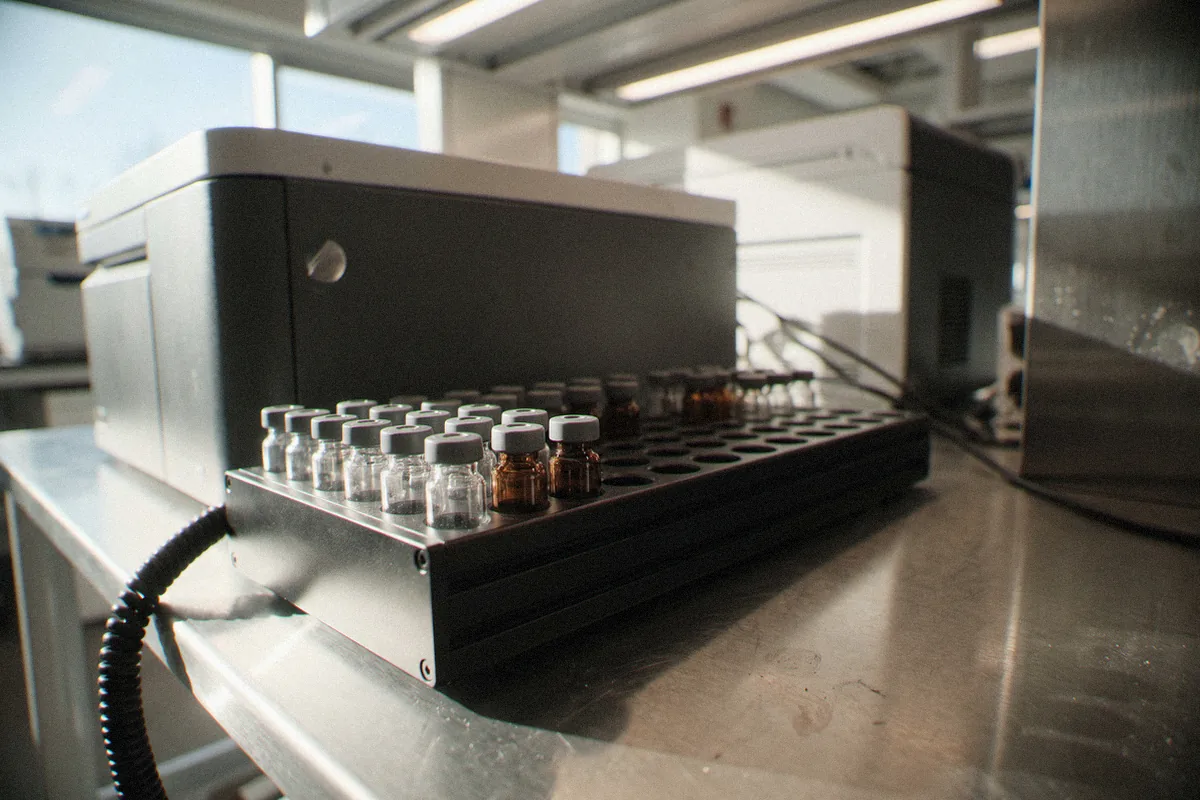
Identity comes first because everything downstream is conditional on it. An endotoxin figure for a vial containing the wrong compound is a correct measurement of an irrelevant thing. Identity is established by mass spectrometry, with the theoretical and measured masses and their difference stated on the certificate.
Purity follows, by reversed-phase chromatography at 214 nm with the chromatogram attached rather than reduced to a single number. The chromatogram is what shows whether the gradient resolved the impurity classes that matter for that sequence, principally deletion sequences, oxidised residues and deamidated forms.
Content is the question buyers think purity answers. Net peptide content by combustion elemental analysis, read alongside water by Karl Fischer and counter-ion by ion chromatography, closes the mass balance and converts a percentage into milligrams.
Only then do the parenteral safety determinations mean anything: endotoxin, microbial enumeration, and where the product claims sterility, an actual sterility test.
| Component | Determined by | Typical | Of 10 mg |
|---|---|---|---|
| Peptide | Combustion elemental analysis | 78 percent | 7.8 mg |
| Trifluoroacetate | Ion chromatography | 13 percent | 1.3 mg |
| Water | Karl Fischer | 8 percent | 0.8 mg |
| Salts and residue | Residue on ignition | 1 percent | 0.1 mg |
Methionine, cysteine and tryptophan oxidise, and the oxidised forms are chromatographically distinct. Asparagine and glutamine deamidate over time, producing isoaspartate species that often only partially resolve and that accumulate as a function of storage rather than manufacture.
Peptides with many basic residues carry proportionally more counter-ion, so a highly charged sequence will show a larger gap between purity and content than a neutral one. That gap is predictable and its absence from a certificate is a stronger signal than its size.
Recombinant proteins raise a separate question. Growth hormone dimerises, and because a dimer is chemically still growth hormone, a purity determination does not register it as an impurity. It requires size exclusion chromatography as a distinct determination, and only the 191 amino acid form is somatropin: the 192 amino acid variant is a different molecule and is reported as such.
Multi-component preparations are priced and analysed per component, because each one needs its own reference standard, its own identity confirmation and its own quantitation. A blend of three peptides is three determinations that happen to share a vial.
Where components co-elute, the separation has to be developed rather than assumed, and where a reference standard is unavailable for one component, that component is reported as not determined rather than estimated from the others.
Identity by mass spectrometry
Is the labelled compound actually present?
RP-HPLC-UVChromatographic purity
What fraction of the peptide-related material is the target?
CHNS / AAANet peptide content
How many milligrams of peptide are actually present?
Karl FischerWater content
How much of the mass is water?
IC / LC-MSTrifluoroacetate counter-ion
How much of the vial mass is counter-ion?
LAL / rFCBacterial endotoxins
Is the material pyrogenic?
USP <61>Microbial enumeration
What is the bioburden?
USP <71>Sterility
Is the product sterile?
ICP-MSElemental impurities
Are there heavy metals, and at what concentration?
GC-MSResidual solvents
What is left over from synthesis and purification?
| Form | Amount |
|---|---|
| Finished vial, lyophilised | One unopened vial |
| Raw API powder | 30 mg in a sealed glass vial |
| Solution | 1 mL, or 2 mL if endotoxin is requested |
| Microbiology | Two additional unopened units |
| Batch variance | Three or more units from one batch |
Turnaround is confirmed with the quotation. Microbiological determinations are governed by incubation and cannot be shortened by expediting.
What should a complete peptide certificate contain?
Identity by mass with the difference in daltons, chromatographic purity with the chromatogram, net peptide content in percent and milligrams, water content, counter-ion content, and numeric detection limits for every quantitative determination.
Why is my 99 percent pure peptide only 78 percent peptide?
Because purity and content measure different things. Purity is a ratio within the material detected at 214 nm; trifluoroacetate, water and salts are invisible to that detector while still occupying the vial.
Can you test a peptide you do not have a standard for?
No. Without a characterised reference standard there is nothing to compare against, and the determination is declined rather than approximated.
How many units are needed for batch variance?
At least three from a single batch. Units from different batches answer a different question and are reported separately.
Updated 2026-09-01